
Class Action Settlement Advice

Class Action Settlement Advice: a reader asks…
Over the last few months, I’ve received several emails that ask me to register for a settlement payout from a class action court case against a company which I had dealings with in the past. I know that fake stuff is all over the internet these days, so I’m not sure if these are real, or just scam attempts. Advice please?
As I’ve said before, one of the best ways to detect a scam attempt is to check the actual email address in the From line (not the name, which can be anything). If the domain name (the part after the @ sign) doesn’t match the official company name, it’s a fake. There are a ton of emails circulating online and landing in your inbox that come from obscure or random email addresses and purport to be from legitimate companies. Recently, I’ve seen plenty (not) coming from Ace Hardware, Nordstroms, UPS, Lowe’s, Home Depot, Marriott, AAA (auto club), the AARP, and even government agencies like the Social Security Administration.
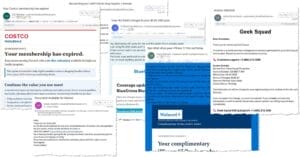
Scammers are hard at work trying to separate you from your money, and as time goes by, you’ll see even more looking like they’re coming from your bank or credit card company, companies you’ve interacted with in some way, or other well-established companies. My advice is for all of us to treat any unsolicited email with a high degree of suspicion, e.g., guilty until proven innocent. As to the ‘proven’ part, that’s up to you to do some research.
In the case of class action settlements/litigation notices, it can be a little harder, since they won’t come from the company in question but from a lawyer’s or legal firm’s website set up specifically for that class action suit. Before you click the link to file a claim or sign on to the suit, you should do a little investigating on your own. An online search should suffice, as long as you structure your query in plain language. Such as, “Is there a legitimate class action suit by (litigant) against (company name), and where do I file a claim?” Look through the search results, particularly for websites of official government or legal entities. You can also ask, “Is an email from (litigant) for a class action lawsuit against (company name) a scam, or is it real?” These kinds of queries often yield ample evidence of real or fraudulent intent behind such emails.
This same kind of search query language can be used to check the validity of just about any other email you might suspect. There are also online sources you can check for scams, such as Snopes.com, the FTC, the Better Business Bureau Scam Tracker, or (for our British readers) citizens advice. I will say that a well-structured online search query can often yield enough evidence to verify an email in just a few seconds. For example: “I received an email that says (quote from the subject line), is this a scam?”
Last bit of advice: be on your guard with your email inbox, incoming text messages, incoming phone calls, basically anything that you didn’t ask for. Be especially wary if they have alarming warnings. If they provide a number to call, don’t call it. Do your research separately before you take any action. Practice safe computing, please!
This website runs on a patronage model. If you find my answers of value, please consider supporting me by sending any dollar amount via:

(@PosiTek)

(Support@PosiTek.net)

(using any credit card)
 Author: Chris Gardner
Your Tech Coach at PosiTek.net
Author: Chris Gardner
Your Tech Coach at PosiTek.net
There are currently 1299 reader comments on published articles, care to join in? Use the Leave a Comment form below/at the bottom of any existing comments. This is a good place to ask follow-on questions on this subject.